


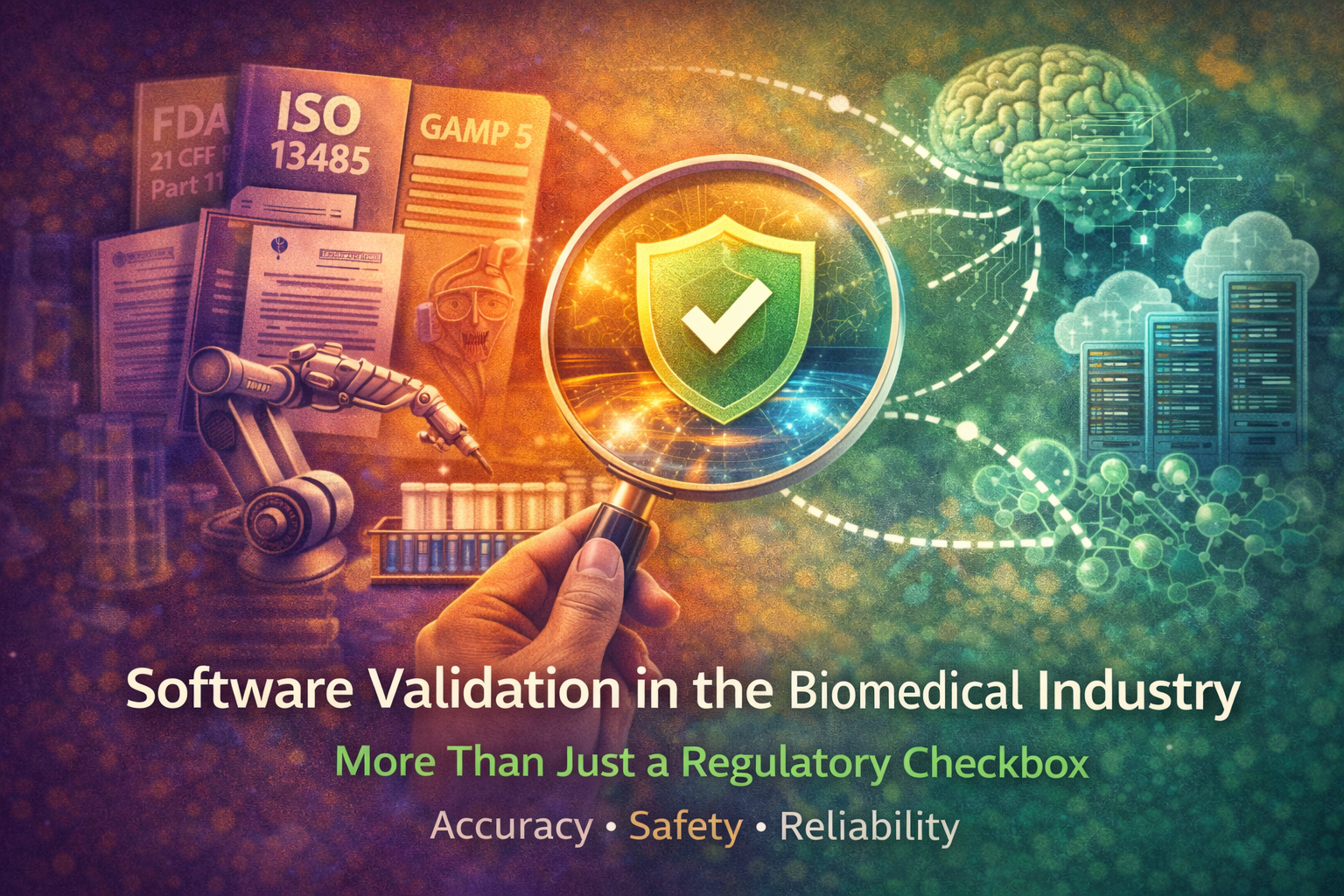
Software has become part of our lives and a big part of the world around us, from electric cars to air conditioning, but when it comes to our health, software needs to be handled differently. In the biomedical industry, software isn’t just a convenience—it can be a matter of life and death. Whether controlling laboratory equipment, managing patient records, or monitoring clinical trials, software plays a critical role in safety, compliance, and innovation.
That’s why software validation is more than just a regulatory requirement—it’s a foundation for trust, reliability, and patient safety.
What is Software Validation?
Software validation is the documented process of ensuring that a software system meets its intended purpose and consistently performs as expected in its operational environment.
In biomedical contexts, validation ensures accuracy, reliability, and compliance with strict industry regulations such as FDA 21 CFR Part 11, EU Annex 11, ISO 13485, and GAMP 5 guidelines.
Why Software Validation Matters in Biomedicine
- Risk Reduction – Detecting software issues early prevents safety hazards and costly recalls.
- Regulatory Compliance – Regulatory bodies require documented validation for any software that affects product quality or patient safety.
- Data Integrity – Ensures biomedical data is accurate, secure, and traceable.
- Operational Efficiency – Well-validated systems run more smoothly and require less emergency troubleshooting.
Best Practices for Software Validation in the Biomedical Industry
- Plan Before You Validate – Start with a Validation Master Plan (VMP) to outline scope, responsibilities, and risk assessment.
- Use a Risk-Based Approach – Focus validation efforts on high-risk systems.
- Document Everything – Validation is only as strong as the documentation that supports it.
- Work Cross-Functionally – Engage QA, IT, R&D, manufacturing, and regulatory teams.
- Keep It Continuous – Updates, patches, and system changes all require re-validation.
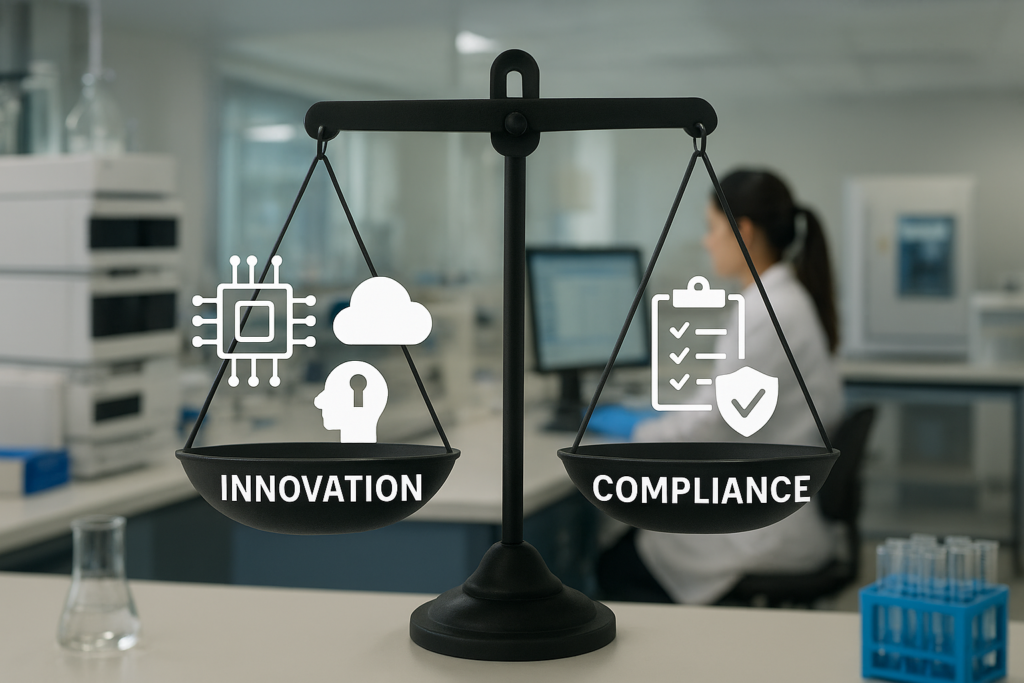
Pitfalls to Avoid
- Skipping User Requirement Specifications (URS) – Missing requirements can lead to validation gaps.
- Ignoring Failure Testing – Only testing “happy paths” leaves vulnerabilities.
- Weak Change Control – Even small changes can have big compliance impacts.
Looking Ahead: AI and Advanced Technologies
The biomedical industry is undergoing a rapid digital transformation. Artificial Intelligence (AI), automation, cloud-based platforms, and advanced analytics are changing how we collect, process, and interpret biomedical data. While these technologies bring unprecedented opportunities, they also introduce new validation challenges.
In clinical diagnostics, drug discovery, and patient monitoring, AI algorithms are being used to identify patterns, make predictions, and recommend treatments. But unlike traditional static software, AI systems, especially those based on machine learning (ML)—can evolve over time as they learn from new data. This “algorithm drift” means validation cannot be a one-time activity; it must include continuous monitoring and periodic re-validation.
Regulators, including the FDA and EMA, increasingly expect that AI models used in healthcare be explainable. Black-box algorithms may be effective but are difficult to validate without clear visibility into their decision-making process.
More biomedical companies are using cloud-based Laboratory Information Management Systems (LIMS), Electronic Quality Management Systems (eQMS), and data analytics tools. While cloud platforms offer scalability and remote accessibility, they require specific validation strategies, including vendor audits, data security assessments, and shared responsibility models for compliance.
Automated Data Pipelines – Advanced automation in manufacturing and clinical trials reduces manual work but creates complex interconnected systems. Validating such systems requires ensuring that each automated step maintains data integrity and traceability throughout the process.
Some biomedical device manufacturers are beginning to use digital twins—virtual replicas of physical systems—for design and performance testing. While this innovation can shorten development cycles, it adds another layer of software validation, ensuring that simulations accurately reflect reality.
As biomedical technology evolves, so must our validation practices. Future-ready validation will be dynamic, risk-based, and integrated with continuous quality monitoring—not just a static, one-off exercise.
The Value of Professional Training
In the biomedical field, regulations, technologies, and best practices for software validation evolve constantly. What was compliant two years ago may no longer meet today’s expectations. That’s why ongoing professional training is not just a nice-to-have—it’s a critical investment.
Structured training gives professionals the chance to:
- Stay updated on the latest regulatory changes and emerging validation methodologies.
- Gain practical insights from real-world case studies in biomedical environments.
- Exchange ideas with peers and learn from the challenges and successes of other organizations.
- Build confidence in applying both established and innovative validation approaches.
By continuously upgrading skills, biomedical teams can ensure that their software remains compliant, reliable, and future-ready—no matter how fast the technology landscape changes.
Want to make sure your team is compliant and future-ready? <add link>