


In the world of medical devices, risk is never zero. Whether you’re designing an implantable pacemaker or a simple diagnostic app, risk management is the foundation of ensuring patient safety, regulatory compliance, and market success.
Modern risk management is far more than a checklist or a regulatory formality. It’s a systematic, lifecycle-based process embedded into every stage of medical device development, production, and post-market surveillance.
The standard that defines this process is EN/ISO 14971:2019, the internationally recognized framework for risk management of medical devices and in vitro diagnostics.
Historically, risk management in healthcare focused on correcting failures after they occurred. This reactive approach led to a patchwork of controls and inconsistent product safety.
In the 1990s and early 2000s, a more proactive, structured model emerged—rooted in systems engineering, FMEA (Failure Modes and Effects Analysis), and hazard analysis.
With the growing complexity of devices, especially combination products and software-driven technologies, the need for standardized risk methodologies became urgent.
This led to the evolution of ISO 14971, which guides manufacturers to:
- Identify known and foreseeable hazards
- Estimate and evaluate associated risks
- Control those risks
- Monitor the effectiveness of the controls throughout the product lifecycle
Maintaining an effective Risk Management File (RMF) is not a one-time activity, it’s an ongoing, cross-functional discipline that spans design, production, clinical affairs, regulatory, and quality.
A Real-World Example: The Therac-25 Tragedy
Between 1985 and 1987, the Therac-25, a computerized radiation therapy machine developed by Atomic Energy of Canada Limited (AECL), was involved in at least six serious accidents in the U.S. and Canada. Several patients received radiation overdoses up to 100 times the prescribed dose, leading to severe injuries and patient deaths.
This catastrophic failure wasn’t due to a hardware malfunction—but rather to undetected software errors, lack of hardware interlocks, and poor risk management practices.
The Therac-25 case is not just a story from the past—it’s a warning still relevant in the age of AI-based diagnostics, connected devices, and real-time health monitoring systems.
Many of today’s medical technologies involve black-box algorithms, remote software updates, and complex user interfaces. Without rigorous risk analysis, effective training, and an embedded culture of safety, the same types of failures can recur in new forms.
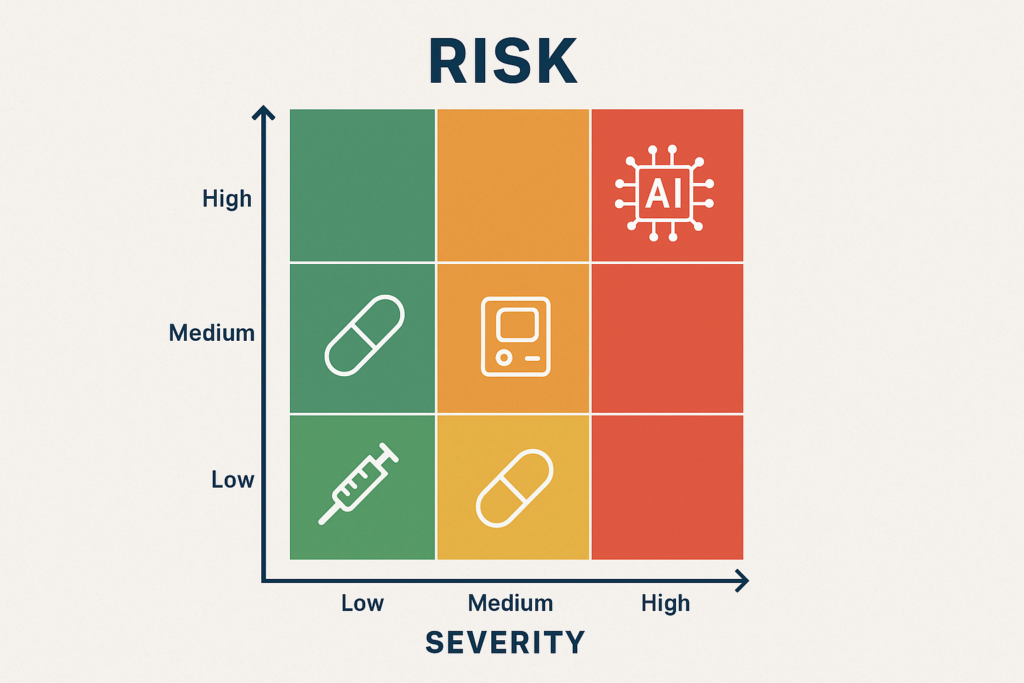
EN/ISO 14971:2019 – The Modern Standard for Risk Management
The latest version, ISO 14971:2019, represents a shift toward integration, traceability, and risk-benefit transparency.
Key updates include:
- Emphasis on benefit-risk analysis, not just risk avoidance
- Expanded requirements for production and post-production data
- Clarified expectations for risk evaluation criteria
- Focus on the entire device lifecycle, including software updates and cybersecurity risks
- Alignment with EU MDR/IVDR through EN ISO 14971:2019+A11:2021
For EU compliance, the harmonized EN version is essential. Manufacturers must ensure their Risk Management File (RMF) satisfies both ISO and EU expectations.
Latest Trends: The Impact of AI, SaMD, and Digital Health
Medical device risk management is evolving quickly, especially in areas involving Software as a Medical Device (SaMD) and Artificial Intelligence (AI). These technologies bring new risk types:
- Algorithmic bias
- Black-box decision making
- Unpredictable performance after real-world updates
- Cybersecurity vulnerabilities
Key Risk Management Considerations for AI-Based Devices:
- Data quality and representativeness
- Explainability and transparency of models
- Post-deployment monitoring (continuous learning systems)
- Integration with IEC 62304 (software lifecycle) and ISO/TR 20416 (post-market surveillance)
In AI-based systems, traditional risk control methods may be insufficient. Dynamic risk models, real-world performance tracking, and cross-functional collaboration are now essential.
Sustaining a Compliant and Robust Risk Management File
Why Professional Training Matters:
- Misinterpretation of ISO 14971:2019 can lead to audit findings, product recalls, or patient harm
- Risk documentation must align with technical files, clinical evaluation, usability, and PMS
- New technologies (AI, cybersecurity, combination products) require updated risk methodologies
- Regulatory agencies now expect risk-aware teams—not just risk documents
Upskilling quality, R&D, and regulatory teams helps prevent gaps and strengthens inspection readiness under FDA, MDR, and MDSAP frameworks.
You can make sure your teams are up-to-date with the latest, in our upcoming professional course <add link>
Conclusion: Managing Risk Is Managing Trust
In the highly regulated, high-stakes world of medical devices, risk management is not a checkbox—it’s a culture.
From early-stage design to post-market vigilance, ISO 14971 provides the structure, but you can bring it to life!
As technologies evolve and global regulations tighten, companies that embed risk thinking into their DNA—and continuously train their teams—are best positioned to innovate safely, efficiently, and ethically.
A well-maintained Risk Management File isn’t just about compliance. It’s a reflection of your organization’s commitment to quality and patient safety.