
 How ISO 13485 and FDA QMS are coming together through the QMSR
For decades, medical device manufacturers aiming to sell their products in both the United States and international markets have faced a major compliance challenge: navigating two distinct but overlapping quality management systems—FDA’s Quality System Regulation (QSR) and the international ISO 13485 standard.
- In 1996, the U.S. Food and Drug Administration (FDA) published 21 CFR Part 820, also known as the QSR, to regulate the quality systems of medical device manufacturers selling in the U.S.
- Around the same time, the International Organization for Standardization (ISO) developed ISO 13485, a global standard designed to ensure the consistent design, development, production, and post-market support of medical devices worldwide.
While both frameworks shared a similar goal—ensuring the safety and effectiveness of medical devices—their terminology, structure, and documentation expectations varied significantly. This created complexity, duplication of efforts, and compliance fatigue for global companies.
Diverging frameworks, common goals
Over the years, many manufacturers developed dual quality systems to comply with both the FDA and ISO requirements. This included:
- Running parallel audits
- Duplicating procedures for document control, CAPA, design controls
- Managing different expectations for risk management, validation, and training
While this ensured compliance, it often led to inefficiencies, inconsistencies, and higher operational costs.
However, as the globalization of the medical device industry accelerated, and as regulatory convergence efforts gained momentum, it became increasingly clear that harmonizing these quality systems was not only logical—it was necessary.
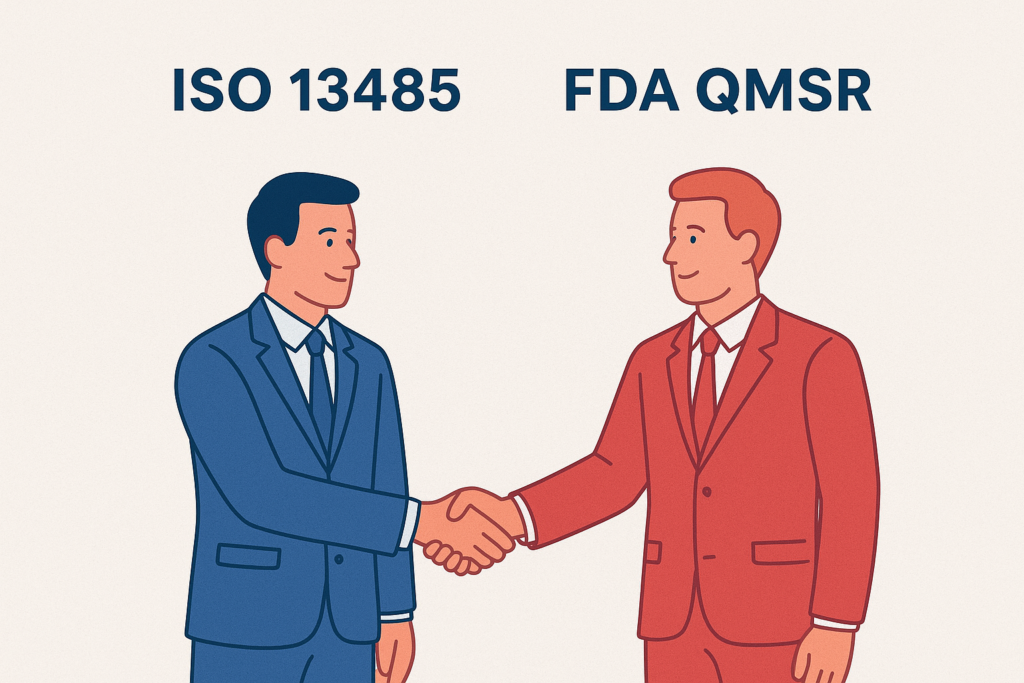
FDA’s Strategic Shift: The Birth of the QMSR
In 2023, after years of industry consultation and public discussion, the FDA made a landmark announcement:
It would replace the existing QSR (21 CFR Part 820) with a new regulation called the Quality Management System Regulation (QMSR), which incorporates ISO 13485:2016 by reference.
What does this mean?
- FDA is aligning its quality system regulation with the globally recognized ISO 13485 standard
- This will reduce the burden on manufacturers who previously had to comply with two systems
- The FDA will retain certain U.S.-specific requirements, particularly around records, reporting, and enforcement
The QMSR represents a convergence of international and U.S. regulatory expectations—a strategic move to enhance global harmonization, improve device quality, and reduce regulatory complexity.
Why this matters for the industry
✔ For Manufacturers:
- Streamlined compliance: A unified system means fewer duplicative audits and harmonized documentation.
- Improved market access: Products designed under ISO 13485 will more easily meet U.S. requirements.
- Better risk management: ISO 13485 places a stronger emphasis on risk throughout the product lifecycle, aligning with modern quality principles.
✔ For Regulatory and Quality Teams:
- Updated procedures and training will be needed to align legacy QSR-based systems with ISO-based expectations.
- There will be a transition period, but manufacturers will be expected to demonstrate competence in both frameworks during inspections.
✔ For Patients:
- Harmonization promotes higher global standards and faster access to safe and effective devices.
The growing importance of professional training
With the introduction of the QMSR, regulatory professionals, quality managers, and auditors must update their knowledge and competencies. Key reasons why training is now essential:
- Many professionals are familiar with QSR or ISO 13485, but not both. The QMSR demands fluency in both frameworks.
- Terminology differences, such as “corrective and preventive action” (CAPA) vs. “nonconformity and corrective action,” need to be clearly understood.
- Teams must know how to translate ISO language into FDA expectations, especially when it comes to records, complaints, post-market surveillance, and enforcement.
Investing in a professional course will be key for successful transition—and a competitive edge.
Find out more about our upcoming professional course <add link>
Conclusion: Two Systems, One Global Standard
The FDA’s move to adopt ISO 13485 through the new Quality Management System Regulation marks a transformational moment in medical device regulation. It simplifies compliance, promotes global alignment, and reflects a modern approach to quality and risk management.
But with this convergence comes the need for education, preparation, and proactive system updates. Organizations that act early—by training teams, revising procedures, and understanding both regulatory languages—will be best positioned to succeed in this new quality landscape.